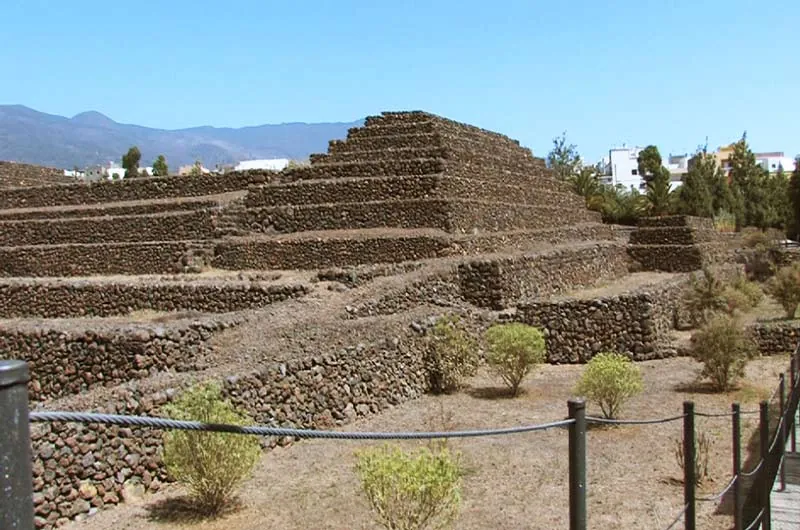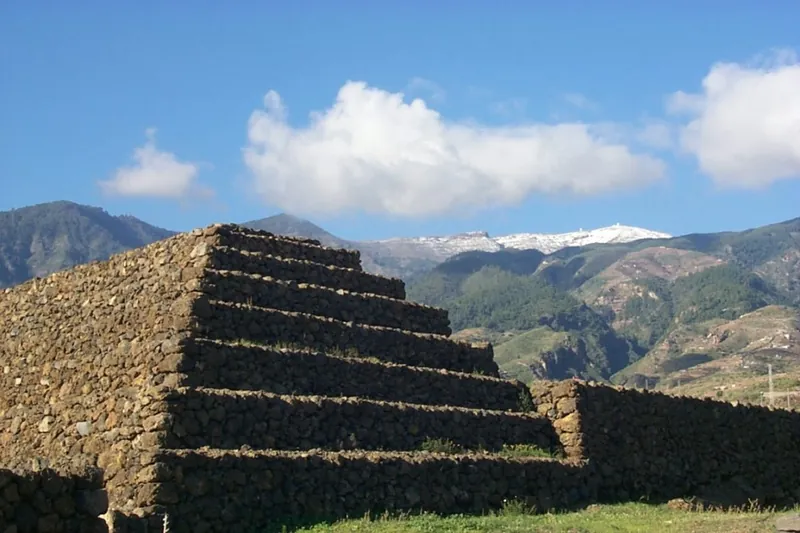
These are rectangular pyramids built on five levels, resembling the Aztec and Mayan pyramids of Mexico. One of the most widely accepted theories about their construction is that they were built by local farmers of old, who piled up the stones turned up when ploughing their fields (a typical practice in the Canary Islands). According to accounts handed down by Tenerife’s early inhabitants, it seems that similar pyramids were also built elsewhere on the island, but were later demolished so that the stone could be reused for other buildings.
In 1991 the renowned researcher Thor Heyerdahl studied the pyramids and showed that they were not just random heaps of stones, but had been built to a precise plan. He also managed to demonstrate that they were made not from field stones but from pieces of volcanic rock. All the pyramids have a stairway on their western side; climbing it, you can watch the sun rise on the morning of the winter solstice. On the day of the summer solstice, a double sunset can be seen from the platform of the tallest pyramid: the sun sinks behind a mountain peak, disappears and then reappears against the enchanting backdrop of the Güímar valley.
No one has yet been able to establish when the pyramids were built. The 65,000-square-metre site where these important historic structures stand opened to the public in 1998 as an ethnographic park (Parque Etnográfico Pirámides de Güímar – for more information, visit the dedicated websites www.piramidesdeguimar.es and www.piramidesdeguimar.net).
Main beaches in the area: Playa del Puertito de Güímar, Playa de la Entrada, Playa de la Viuda and Playa de Samarines, also called Playa de los Guanches (all with the characteristic black sand).
Photo gallery