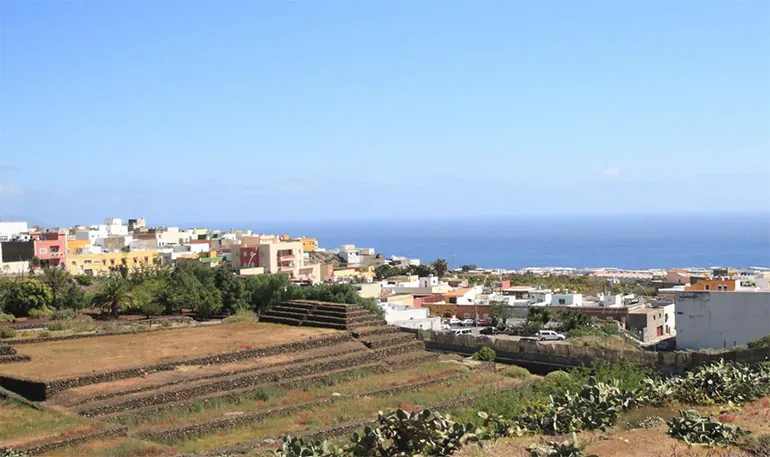
Güímar is a historic town of around 18,000 inhabitants in the south-east of Tenerife, bordering the municipalities of Arafo, Fasnia and La Orotava. To the west, its territory takes in the island’s mountainous backbone, whose highest point is Izaña, an important centre for astronomy (and home to one of the oldest meteorological observatories in Spain). The area has some beautiful nature trails, notable for their sudden changes of scenery.
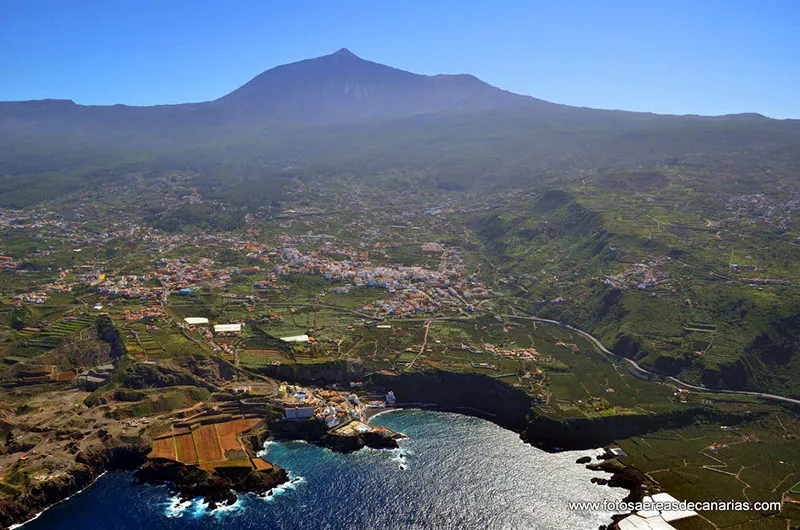
Güímar lies in a valley that, according to geologists, was formed by an ancient lava flow that reached all the way to the sea. In the coastal part of the valley the ancient eruption is still clearly visible; over time it has shaped an unusual landscape that is well worth a visit. What makes this area unique is its constant sunshine: the Güímar Valley records the highest number of hours of sunshine on the whole island (3,448.5 hours a year).
The town’s history is closely bound up with the past, and in particular with the Guanches, a people of Berber origin who arrived in the Canary Islands around 2500 BC. Güímar was in fact the seat of one of Tenerife’s ten menceys (kings).
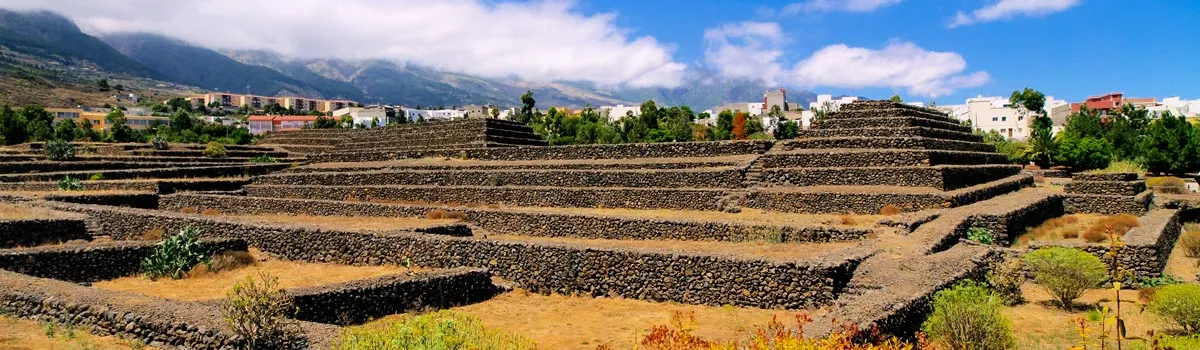
The economy is based on tourism, thanks to the beautiful scenery and the famous Pyramids of Güímar, which are well worth a visit. There are also numerous noteworthy historic buildings and sites.
Besides the valley and the historic centre, don’t miss the Puertito de Güímar, a pretty little harbour looking out over the ocean.
Places of interest: the Pyramids of Güímar
Main beaches in the area: Playa del Puertito de Güímar, Playa de la Entrada, Playa de la Viuda and Playa de Samarines, also called Playa de los Guanches (all with the characteristic black sand).
Photo gallery