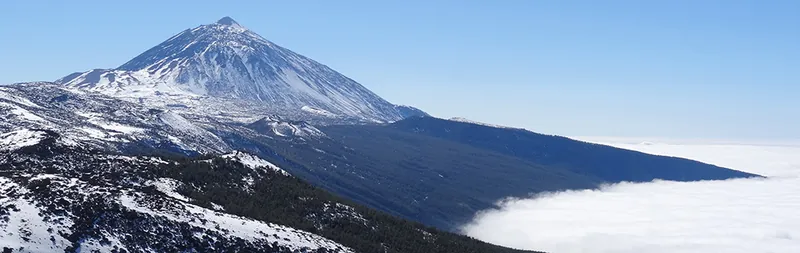
Teide National Park is the heart of Tenerife and its most famous attraction. At its centre rises Teide, a 3,715-metre stratovolcano and the highest mountain in Spain (many guides still give the old figure of 3,718 metres). All around it lies the vast caldera of Las Cañadas, a landscape of lava flows, rocks of every colour and Canary Island pines that seems to belong to another planet.
The park was created in 1954 and has been a UNESCO World Heritage Site since 2007. It covers around 19,000 hectares, almost all of it above 2,000 metres: even when it’s hot on the coast, the air up here is cool, the sun is very strong and in winter it can snow (see also our page on Tenerife’s climate).
The cable car
The cable car starts at 2,356 metres, at km 43 on the TF-21 road, and in less than 8 minutes climbs to La Rambleta, at 3,555 metres. From here two short scenic trails lead to the viewpoints of La Fortaleza and Pico Viejo, with its huge crater. The summit is about 160 metres higher, and you need a permit to reach it.
Tickets are sold online only, on the official cable car website, and places are limited, so it’s worth booking ahead, especially in the holiday season. The cable car may stop running because of wind or bad weather: if it does, anyone with a booking is notified the same morning and can change the date or ask for a refund. Children under 3, pregnant women and people with heart problems are not allowed on the cable car.
Climbing to the summit: you need a permit
Access to trail no. 10 (Telesforo Bravo), which leads from La Rambleta up to the summit crater, is limited. You need a permit in your name, booked on the Tenerife ON portal run by the Cabildo (the island council): new dates are released every Monday at 7:00 (Canary Islands time), up to 56 days ahead, and places go quickly. On the day of the climb you must carry the permit and an identity document in the same name.
Since 19 January 2026 there has been a fee for permits in the time slots when the cable car is running, from 9:00 to 17:00: €15 if you don’t live in the Canary Islands, less for residents of the other islands, while people who live in Tenerife go free. The Montaña Blanca trail, which climbs on foot to La Rambleta, is also booked on Tenerife ON and costs non-residents €6 on weekdays and €10 at weekends.
To watch the sunrise from the summit, there’s also the Refugio de Altavista, a mountain hut at around 3,260 metres that reopened in 2026. You reach it on foot along the Montaña Blanca trail, and an overnight stay includes the permit to climb to the top the next morning, between 6:00 and 9:00. You book on the hut’s website; no meals are served and you need to bring a sleeping bag.
On the high-altitude trails, hiking boots, long trousers and a fleece are compulsory, even in summer: if you don’t have them, you may be turned back even with a booking. The climb is not suitable for anyone with heart, breathing or mobility problems.
What to see in the park
- Roques de García: the most photographed rock formations at Teide, opposite the Parador hotel. A circular trail of about 3.5 km (2 hours, easy) runs around the rocks and down towards the Llano de Ucanca; access is open to all and no booking is needed.
- Llano de Ucanca: the largest plain in the park, dominated by the rock known as La Catedral.
- Minas de San José: an almost lunar landscape of pale pumice, along the TF-21.
- Mirador de las Narices del Teide: on the TF-38, this viewpoint looks out over the lava flows from the 1798 eruption on the flank of Pico Viejo, the most recent in the park.
- Visitor centres: El Portillo, with a botanical garden, and Cañada Blanca, next to the Parador, both open every day. Cañada Blanca requires a ticket, which you can book on Tenerife ON or buy from the machines on site.
Starry skies
Thanks to its clear skies, Teide is recognised as a Starlight Tourist Destination. Many agencies organise sunset excursions and stargazing with telescopes. By day you can visit the Teide Observatory, run by the Instituto de Astrofísica de Canarias, on guided tours booked through the cable car website (not from December to March).
Getting there
The roads up to the park are the TF-21, from La Orotava in the north and from Vilaflor in the south, the TF-24 from La Laguna and La Esperanza, and the TF-38 from Chío, on the western side. The cable car station is about 45 km from Puerto de la Cruz, 47 km from Los Cristianos and 64 km from Santa Cruz. These are mountain roads, so allow extra time and fill up with fuel before you head up.
By bus, there are two TITSA routes, each with just one service a day: the 342 leaves Costa Adeje bus station at 9:25 (Los Cristianos at 9:40) and returns from the park in the afternoon; the 348 leaves Puerto de la Cruz at 9:30 (La Orotava at 9:45) and returns from the Parador at 16:00. Check the latest timetables on the TITSA website.
In winter, snow and ice can close the roads for a few hours or a few days, so check the Cabildo’s alerts before you set off.
Park rules
In the park you may not collect stones or plants, leave the trails in protected areas, camp or fly drones without authorisation; since June 2026 smoking outdoors has also been banned. Park only in marked spaces and take your rubbish away with you.
Useful information
- Cable car: first ascent at 9:00; from late October to December the last ascent is at 16:00 (later in other months). Return tickets from around €42 for non-resident adults, online only at volcanoteide.com.
- Summit permit: at tenerifeon.es, up to 56 days in advance; €15 for non-residents for slots between 9:00 and 17:00.
- Visitor centres: El Portillo and Cañada Blanca, daily from 9:00 to 16:00.
- Buses: TITSA 342 from Costa Adeje and Los Cristianos, TITSA 348 from Puerto de la Cruz and La Orotava; one service a day.
Opening times, prices and services may change: please check the official website before your visit.