Tenerife has two airports, a good bus network and a tram between Santa Cruz and La Laguna; to explore the island at your own pace, though, a car is still the most convenient option. Here’s how to plan your travel.
By air: the two airports
- Tenerife South: the main airport, in the municipality of Granadilla de Abona, on the TF-1 motorway. Almost all international flights land here. It is about 18 km from Los Cristianos, 20 km from Costa Adeje and 63 km from Santa Cruz.
- Tenerife North: officially called Tenerife Norte-Ciudad de La Laguna, it is at Los Rodeos, above La Laguna, on the TF-5 motorway. It mainly handles flights to the other Canary Islands and mainland Spain. It is about 10 km from Santa Cruz and 26 km from Puerto de la Cruz.
Tenerife South has direct flights from many European airports, with low-cost and charter airlines. Many routes are seasonal and more frequent in winter; alternatively, you can fly via a Spanish airport such as Madrid or Barcelona.
From the airports: buses and taxis
TITSA buses leave from the ground floor, in front of the arrivals hall. The main routes are:
- 040: Tenerife South – Los Cristianos – Costa Adeje bus station, about every 30 minutes from 5:30 to 21:40.
- 010: Tenerife South – Santa Cruz, roughly every 40 minutes; the journey takes about 55 minutes.
- 711: night bus Santa Cruz – Tenerife South – Los Cristianos – Costa Adeje.
- 343: Puerto de la Cruz – Tenerife North – Tenerife South – Costa Adeje, with only a few services a day.
- 020: Tenerife North – La Laguna – Santa Cruz, every 20–25 minutes.
- 030: Tenerife North – Puerto de la Cruz, taking about 30 minutes.
Taxis are white and metered, and you can only take one from the official rank in front of arrivals; always ask for a receipt. Fares are set by the Government of the Canary Islands, and there is a small supplement for journeys to and from the airports.
Buses (“guaguas”) and trams
In the Canary Islands the bus is called a guagua. The TITSA network covers the whole island: on board you can pay by contactless bank card, at the same price as cash, or in cash with notes of up to €10 – though at night, from 21:00 to 5:30, you’ll need the exact fare. If you’re getting around a lot, there are tourist passes for 1 day (€10) and 7 days (€50), valid on all buses and the tram, which you load onto a ten+ card (€2) or the ten+móvil app. Timetables and routes are on the TITSA website and app.
The tram has two lines: line 1 links Santa Cruz (Intercambiador) with La Laguna (Trinidad) via the university hospital, while line 2 runs from La Cuesta to Tíncer. At peak times there’s a tram every 5–6 minutes, and at weekends line 1 also runs at night. A single ticket costs €1.35 with the ten+ card and €1.10 with the app, and must always be validated on board.
By car
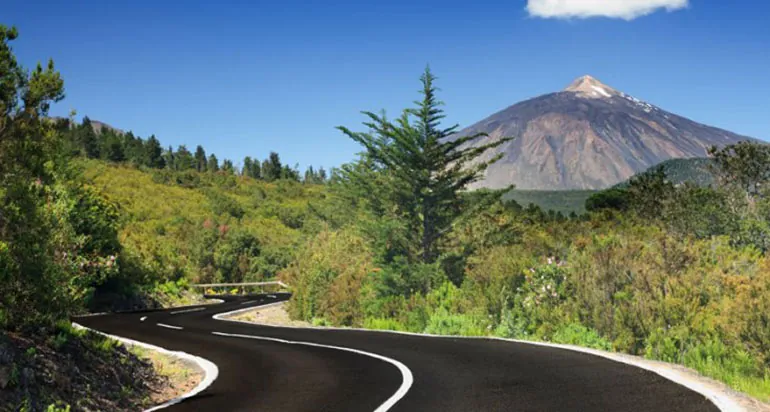
With a hire car you can also reach mountain villages and beaches that are poorly served by buses. Driving licences from EU countries are valid. The main motorways are the TF-1 in the south and the TF-5 in the north; mountain roads, such as those to Teide or Masca, are narrow and winding. In some protected areas access by car is restricted: Punta de Teno, for example, can only be reached by bus or taxi (see our page on Teno Rural Park).
By ferry
From mainland Spain there are ferries to Santa Cruz from Huelva, with Fred. Olsen Express (around 33–34 hours’ direct sailing), and from Cádiz, with Baleària; the Cádiz route is in the process of being reassigned and may change. The journey is long, but it means you can bring your own car.
Connections between the islands are frequent: from Los Cristianos you can reach San Sebastián de La Gomera in about 50 minutes, La Palma in about 2½ hours and El Hierro in about 2 hours 20 minutes; ferries to Gran Canaria leave from Santa Cruz (to Agaete in about 80 minutes, to Las Palmas in about 1 hour 40 minutes). The main operators are Fred. Olsen Express and Baleària.
Before you go
- Documents: EU citizens just need a valid identity card or passport. If you’re travelling from outside the EU, check the entry requirements for Spain before you travel.
- Healthcare: the European Health Insurance Card (EHIC) entitles you to necessary treatment in the public health system on the same terms as residents, but it doesn’t cover private clinics or repatriation, so consider taking out travel insurance. The emergency number is 112.
- Phone and electricity: EU roaming applies, at no extra cost; the mains voltage is 230 volts, with sockets for two round pins, as in most of Europe.
- Shopping: the Canary Islands are outside the EU VAT area (instead of VAT there is IGIC, which is lower). When you return home, the allowances for goods bought outside the EU apply, for example 200 cigarettes and 1 litre of spirits per person.
- Currency: the euro.
Useful information
- Buses: timetables and routes at titsa.com and in the “Titsa en tu móvil” app.
- Tram: metrotenerife.com.
- Airports: flights and services at aena.es.
- Ferries: fredolsen.es and baleariacanarias.com.
Opening times, prices and services may change: please check the official website before your visit.